
塵も積もれば山となる
“Chiri mo tsumoreba yama to naru”
“Even dust, when accumulated, can become a mountain”
With the relentless advance of technology, and the equally relentless fact that none of us has yet discovered how to reverse ageing, 2026 has presented me with some new opportunities … and some new dilemmas.
My wife and I are now in our sixties and, fortunately, in reasonably good health. She is older than I am and has quite reasonably decided that she dislikes airports and dislikes long-haul flights even more.
This created a problem.
For the first time in nearly thirty years, I would have to travel from London to Tokyo without her.
Apart from the interruption caused by COVID-19, we have made an annual trip to Japan since we married in London in 1997. Normally we stay for two or three weeks and make a proper holiday of it. On two previous occasions work had restricted me to seven days away from London, resulting in a rather less ambitious five-night stay.
In 2026 I found myself booking another five-night visit.
This time, however, there was a difference. My adult son had travelled to Japan ahead of me as part of a world tour, and I had the opportunity to join him at a prestigious international event. Owing to my wife’s health constraints, I wanted to spend the minimum possible time away from London while still attending the event with him.
The result was a rather brutal itinerary: approximately 48 hours on the ground in Japan, still suffering from jet lag, a major reception, followed by another 48 hours (to do some shopping) before the long-haul flight home.
This was not tourism. It was like a military operation involving a passport.
I booked a particularly well-appointed hotel close to the venue, not far from the Imperial Palace in central Tokyo. I arrived appropriately dressed and, having explored the neighbourhood around the venue the previous evening, reasonably well orientated.
I was ready. I was also expecting rather more than I received.
Expectations
My Japanese is not especially good, but I have mastered the basics and have made considerable progress through the different levels of formality. I pride myself on being something of a polyglot: I can communicate, with varying degrees of proficiency, in five foreign languages.
Japanese provides an interesting additional dimension. In appropriate circumstances I use formal Japanese; in super-formal situations I can use language designed to exalt my counterpart while humbling myself. And, when necessary, I can abandon diplomatic niceties and become considerably more direct.
The invitation to this particular international event was welcome for two reasons.
First, my son had spent much of 2026 travelling around the world and I wanted to see him.
Second, I wanted to see what this new organisation in Tokyo was actually like.
The event involved 185 delegates from 46 nations. That creates a certain expectation. So did the organisation’s pedigree.
My own professional experience has included PricewaterhouseCoopers, the British Medical Association, CERN and universities including Cambridge, London, Leuven, Harvard and Stanford. I have also had the privilege of being invited to diplomatic institutions and of meeting members of the Royal Family and eminent ambassadors.
I mention this not because I expect a red carpet to be rolled out whenever I enter a building, but because I am not entirely unfamiliar with professional hospitality at an international level.
Outside my professional life, I am deeply involved in the London Tech community. Working with teams of volunteers, many of them software developers, I organise community events for audiences of between 100 and 300 people. I have chaired committees responsible for such events several times.
I am therefore reasonably familiar with the practical requirements of conferences: operations, security, catering, plenary sessions, multiple tracks and breakout rooms. The conferences I organise are carefully planned, carefully resourced, and carefully executed.
I also spent three years as chair of International Business Professionals, a smaller organisation that staged smaller events in Brussels, Amsterdam and London between 1999 and 2009.
And I have spent time as president of a Toastmasters club in London. And as a member of a club in Geneva.
These experiences have taught me one important lesson. Managing volunteers is often harder than managing employees. In business, we have at least the pretence that everyone is working towards the same strategic goals and owes some allegiance to the hierarchy. In a community organisation, everyone tends to have an agenda of their own, accompanied by a greater or lesser commitment to the objectives of the group. It is sometimes remarkable that community events work at all. When they work well, they can be extraordinarily good.
Which brings us back to Tokyo.
The first cup of tea
For reasons that I am now beginning to question, I expected that an international event of this calibre might provide something quite elementary on arrival: hot tea or hot coffee.
It did not.
The Japanese are rightly famous for their courtesy, and a short conversation established that instead of kocha sutoreito … black tea … I would be happy to have ocha, Japanese green tea.
A member of the catering team disappeared into the kitchen. A little later he returned with a glass of iced green tea. At this point I realised that I had failed to specify hotto.
The Japanese quite reasonably drink iced coffee and iced tea during the summer. I had simply failed to make myself sufficiently clear.
So I exchanged the appropriate expressions of gratitude and accepted my fate.
It was my fault. I had asked for tea. I had not asked for hot tea. Miscommunication would prove to be a recurring theme.
Artificial intelligence and natural stupidity
The keynote speaker had prepared an intelligent and engaging presentation on modern technological developments, particularly artificial intelligence. One of the central messages was that we must have the courage to challenge AI when it is wrong. Quite right.
We were told that unless we challenge erroneous output, we risk damaging our own reputations and those of our employers. Again, quite right. The audience, which included international guests who had travelled specifically to attend the event, was encouraged to question, to challenge and to speak up. It was an excellent message. I took it seriously. I suspect the organisers subsequently regretted this.
The morning continued with several thoughtful presentations before the inevitable adjournment for lunch. I was now confident that I would obtain a cup of hot black tea. I was wrong.
The woman with the microphone
Instead, I encountered a member of staff who appeared to have overdosed on sugar before being handed a microphone. She was downstairs, organising delegates for a group photograph. I was on the third floor.
For reasons that remain mysterious to me, the public-address system was delivering a continuous commentary from an extremely enthusiastic woman at a volume suitable for evacuating a railway station.
The content was worse than the volume.
A room full of adults was being addressed as though it contained 10 year old children who had just been released from a school assembly.
The combination of inappropriate language and disproportionate volume became intolerable.
Eventually I left the reception room and stood in the corridor, where at least my ears were given the opportunity to recover.
I now had no hot tea and diminished hearing. The morning was going well.
The convenience-store solution
I approached a member of the operations team. It was quickly established that the simple guaranteed way for me to obtain a cup of hot tea was to visit the convenience store I had noticed the previous evening. So I did. I returned to the venue carrying a hot tea in a paper takeaway cup. I must have looked like the most eccentric Englishman in Tokyo.
The paper cup also made me easy to identify as the man who had been complaining about the hospitality. Had it not been for the woman shouting into the public-address system at a room full of adults, I might have restrained myself and said nothing about anything.
But there are limits. A physical assault on my ear drums was the last straw.
The elusive toilet
Then things became even more impressive.
The sign directing delegates to the toilets pointed towards a locked door marked Emergency Exit.
I pointed this out to a member of staff.
He immediately directed me towards the actual toilets and, to his credit, moved the offending sign to the correct position.
One problem solved. One might almost call this kaizen. There was still lunch.
Lunch presented another challenge.
Paella.
With chopsticks.
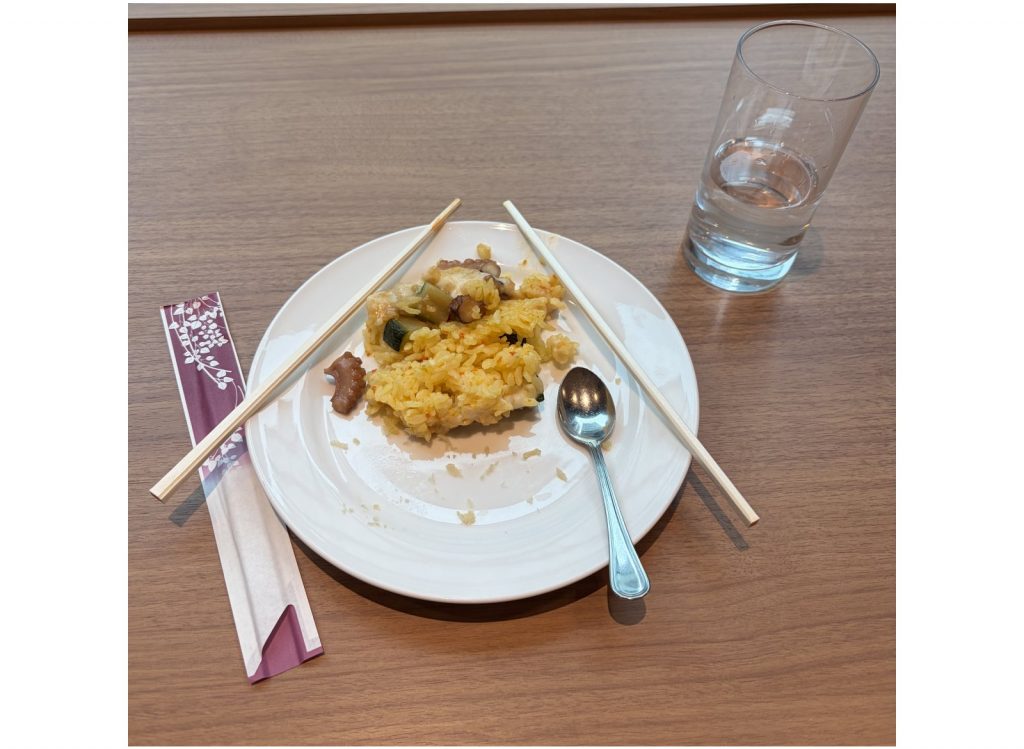
I have some experience of cultural incompatibility involving food. On one occasion in London I was served sushi with a fork. Despite the cultural contradiction, I managed to complete the operation. Eating paella with chopsticks, however, proved to be beyond even my considerable powers of improvisation. I searched for a fork or spoon.
The only implement I could find was a teaspoon of almost comic proportions.
I can report that it is technically possible to eat paella with a tiny teaspoon. It is not, however, an experience I recommend.
But there was a more fundamental problem. It was not always possible to obtain a glass of water.
The elusive glass of water
At the bar, I politely asked in formal Japanese for a glass of water. The member of staff reached for a two litre bottle and a glass.
At that precise moment, another Englishman standing at the bar engaged me in conversation. I never discovered what happened to my water. Perhaps it arrived. Perhaps somebody else drank it. It would have been the lone glass of water on the bar alongside dozens of glasses of champagne!
Perhaps it remains in Tokyo to this day, a monument to unfinished hospitality. The bar contained ample champagne and fruit juice, all readily available.
Water, however, was apparently a specialist service. This astonished me. In Britain, the provision of drinking water at events of this type is a legal requirement. More importantly, an international event should recognise that not every delegate drinks alcohol or wants to consume sugary fruit juice. I am hardly alone in this. There is a substantial international community of people who drink alcohol rarely or not at all.
Some of us simply want water. And tea. Preferably hot.
Courage to speak up
Eventually I broke away from my conversation with the quaint Englishman, who happened to be discussing precisely the same themes: the courage to criticise things that are wrong and the relentless advance of information technology.
I am a retired schoolteacher of computer science. I had been told that we should challenge technology when it was wrong. I decided to challenge the bar. This time I used rather more direct Japanese.
In English, the sentiment might have been expressed bluntly as:
“Am I getting a glass of water or not?”
Miraculously, a glass of water appeared almost immediately.
Technology had not been required. Nor, apparently, had artificial intelligence.
The Chairman arrives
Not long afterwards, the chairman of the organisation found me.
By this stage I was easy to identify.
I was the demented Englishman, red with rage, and I was carrying a paper cup.
He engaged me in polite conversation.
I have now discovered a useful shortcut to meeting the chairman of a prestigious international organisation: criticise the hospitality.
It saves a great deal of networking!
More seriously, we had an entirely civil conversation in English about the shortcomings of the event. The discussion centred largely on the absence of hot tea and the assault upon my ears.
Both of us were reasonably familiar with international standards of courtesy, and with Japanese society, so I raised the subject of Peter Drucker’s affection for Japan and his interest in kaizen … continuous improvement.
The point was not that everything had been badly done. Far from it. The speakers were generally strong. The keynote presentation was thoughtful. The staff were, for the most part, courteous and willing to help when problems were identified.
The problem was that too many small failures had accumulated.
A missing cup of hot tea is trivial.
A badly positioned toilet sign is trivial.
A teaspoon for paella is amusing.
The absence of readily available drinking water is more serious.
A ground floor public-address system broadcast unnecessarily throughout the third floor at an absurd volume is not merely irritating; it is a failure of basic consideration for the people in the room.
And when these things occur at an event representing an international organisation, involving 185 delegates from 46 countries, the cumulative effect matters.
Reputation is built from the details. Reputations take years to build.
They can be destroyed in minutes.
What happens next?
I expect to return in a year’s time.
That will provide an interesting test. Will the organisation have listened? Will it have acted? Will the lessons have been converted into improvements? That is what kaizen demands.
Today’s blogpost, like yesterday’s conversation, pulls few punches. But the criticism is well intentioned. Indeed, the keynote speaker gave me the justification for making it. He told us to have the courage to speak up when something is wrong. I did.
I also followed a principle I learnt through Toastmasters: commend, recommend, commend.
So let me finish in that spirit. I commend the chairman for taking the criticism seriously and for engaging with a rather eccentric delegate carrying a paper cup.
I commend the quality of several of the speakers and the thought that had gone into the programme.
I recommend that a minority of the speakers obtain recordings of their lacklustre presentations, watch them critically and consider what they could improve.
I recommend that the operations team conduct the same exercise with the event itself.
And I recommend one particularly simple experiment:
Try attending the event as a delegate.
Arrive jet-lagged.
Ask for tea.
Ask for water.
Find the toilets.
Eat the lunch.
Sit in the reception room while somebody shouts through a public-address system.
Then ask yourself whether this is the experience you would want to provide to 185 international guests.
That, after all, is kaizen.
And next year, when I return to this part of Tokyo, I look forward to something considerably less ambitious than technological transformation. I would simply like a hot cup of tea.
No difficulty, no linguistic ambiguity, no ear defenders.
Just tea. Hot tea. Surely that cannot be beyond the wit of an international organisation?
In 45 years of attending conferences, receptions, trade fairs and the like, it appears to be a de facto standard that guests are taken via the registration desk to the tea and coffee station where they can mingle, and chat. And it is normal to provide a floor plan showing where the toilets are. That shows them that you care. In business circles that is a shrewd move.
To neglect the needs of guests who may have travelled a long distance at great cost in time, energy, and expense, is to show them that you do not care. In my experience, that is quite the opposite of the Japanese psyche.
I commend the Japanese as a whole for teaching us giri (義理) and gimu (義務). The concepts of duty and obligation, which they tend to uphold without fail.